Prepare the engine
Freestyle looks like balance and timing, and it is. But balance and timing disappear quickly when your trunk, shoulders and breathing cannot keep up with the third ride in a row.
Health note: this page offers general training information, not medical or physiotherapy advice. If you have pain, an existing injury or a health condition, consult a qualified professional before changing your training.
- RPE
- Rating of perceived exertion: how hard an effort feels, often on Borg's 6–20 scale.
- Work:rest
- Ratio of effort time to recovery time within an interval set.
- Block
- A training phase of several weeks with one main emphasis.
What freestyle actually demands
A typical freestyle session alternates short, intense efforts on the feature with partial recovery in the eddy. Each ride involves explosive trunk rotation, sudden loads through the shoulders, forceful hip and knee action to drive edges, and repeated breath-holding during inversions. Competition rides compress this further: a short timed window, often around 45 seconds at international events, where you want your best moves in both directions. Long, steady paddling builds a useful base, but it does not prepare you for that pattern on its own.
Rotation with control
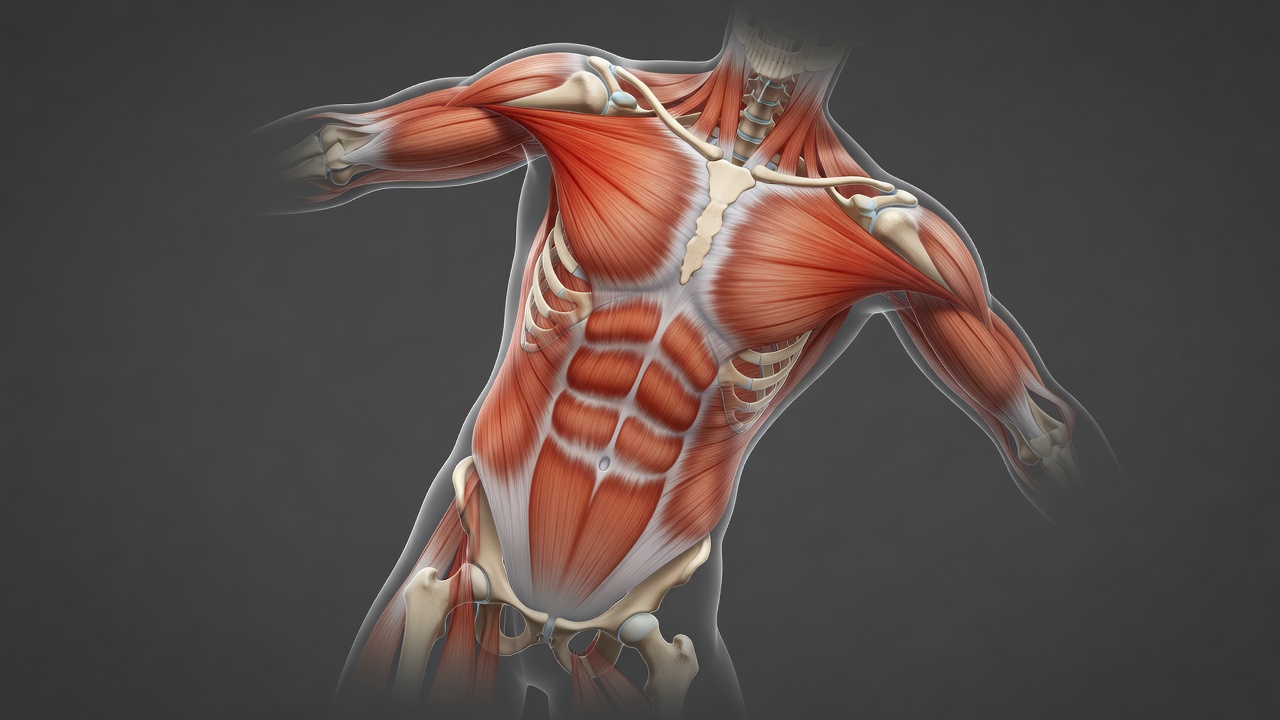
Trunk rotation is the engine of spins, cartwheels and most aerial moves. Train it in stages. Start with controlled, slow movements that teach you to rotate from the hips and mid-back rather than twisting through the lower back: half-kneeling cable or band rotations, and anti-rotation holds such as the Pallof press. Progress to medicine ball rotational throws against a wall once you can control the position, emphasising a quick, crisp release. Rotation that is fast but uncontrolled is exactly what ends sessions early.
Shoulder durability
The shoulder is the most commonly mentioned problem area among whitewater paddlers, largely because high braces and strokes with the arm extended overhead and behind the body place the joint in vulnerable positions under sudden load. On the water, the most effective protection is technique: keeping the paddle in front of the torso and rotating the whole upper body rather than reaching. On land, strengthen the rotator cuff and the muscles around the shoulder blade with external rotation work, rows and controlled pressing. Mobility in the mid-back lets the shoulder stay in a safer position when the boat is inverted.
Repeatable efforts and the aerobic base
A strong aerobic base speeds recovery between rides and lets you train longer with quality. Steady paddling, running, cycling or cross-country skiing all contribute; in the Nordic winter, the last is a natural partner for paddlers. On top of that base, add intervals that mimic the sport: for example, short hard efforts of roughly ride length with longer recoveries, repeated in sets. Use perceived exertion to steer intensity. Gunnar Borg's scale gives a shared vocabulary: hard rides near the top of the scale, recovery near the bottom.
| Day | Session | Main purpose |
|---|---|---|
| Monday | Strength: rotation, rows, cuff work | Durability and power base |
| Tuesday | Water: technique blocks on a friendly feature | Skill acquisition |
| Wednesday | Easy aerobic 40–60 minutes | Recovery and base |
| Thursday | Water: random practice and short ride simulations | Skill under fatigue |
| Friday | Rest or mobility | Adaptation |
| Weekend | Longer water session; intervals if fresh | Volume and repeatable efforts |
Planning across a season
Periodisation, the organisation of training into phases with different emphases, was developed in sport science and is widely associated with Tudor Bompa's book Periodization: Theory and Methodology of Training. You do not need a complex plan. A simple sequence works: a general phase emphasising base fitness and strength, a specific phase where water time and ride simulations increase, and a short taper before key events where volume drops and quality stays high. For paddlers in Finland, where many natural features freeze or drop in winter, the dark months are a natural general phase, with trips south or to artificial courses for water blocks.
Cold water and recovery
Training in cold water costs more energy and slows reactions, which matters for both performance and safety. A drysuit or appropriate thermal layers, shorter sessions and warm-up routines before launching help. Between rides, keep moving gently in the eddy rather than sitting still and cooling. After sessions, prioritise food, fluids and sleep. Recovery is when adaptation happens; missing it turns hard training into accumulated fatigue.
A ten-minute pre-launch warm-up
Light jog or skip, arm circles, thoracic rotations, band pull-aparts, a few controlled squats and lunges with rotation, then easy paddling with progressive edging before the first ride.
Signs to reduce training
Persistent joint pain, falling session quality, poor sleep or lingering soreness beyond a couple of days. Reduce volume and seek professional advice if pain persists.
With water, technique and fitness in place, the final step is putting it together under judging: Shape your competition run.